KOPR — Software for Comet Observers
KOPR is Python 3 software for processing visual comet estimates and CCD image measurements, image calibration and stacking, observation planning, finding charts and comet light-curve analysis.
It is intended primarily for amateur comet observers and can also be used in professional observing workflows where its methods and output formats are appropriate.
Current release: KOPR Live Theta-160 / 0.1.0.dev676
Main workflows
Process Visual Obs.
Reduce visual comet estimates using comparison-star maps, Argelander steps, optional extinction correction and ICQ output.
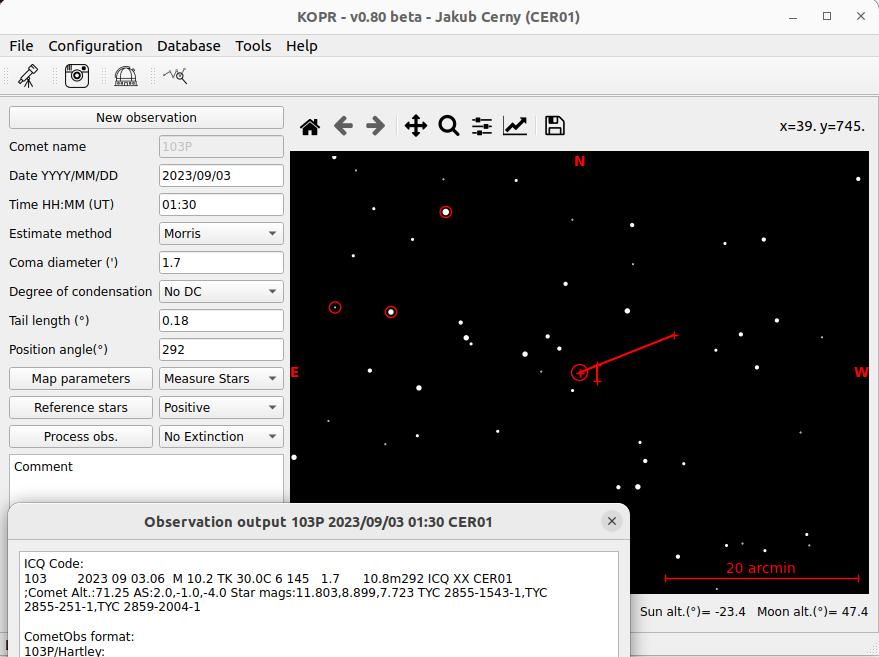
Image Calibration & Stacking
Prepare calibration masters, solve astrometry, inspect image quality and create matched star- and comet-aligned FITS stacks.
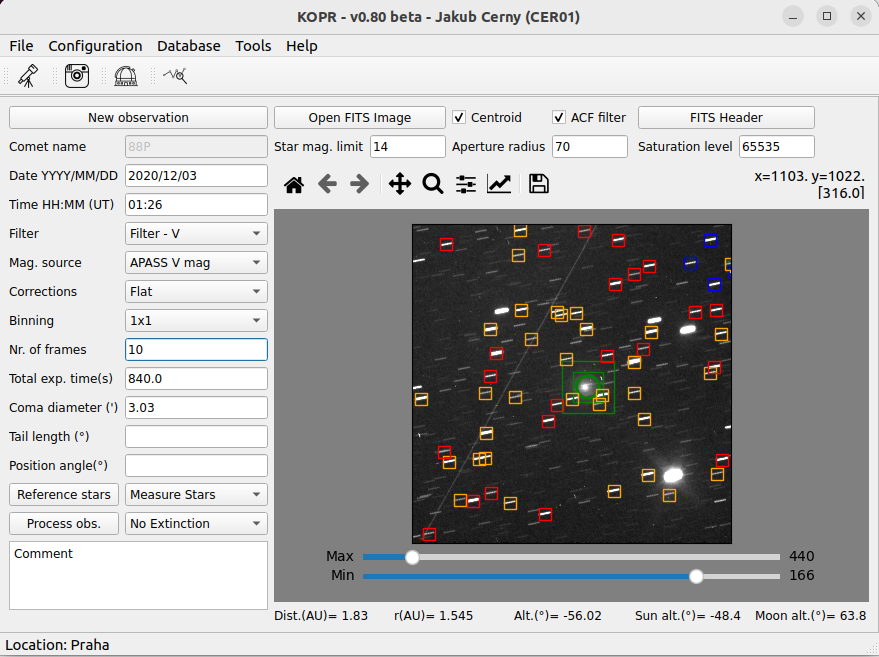
Process CCD Obs.
Measure total comet-coma brightness from solved FITS images with manual or assisted comet-centre and comparison-star selection.
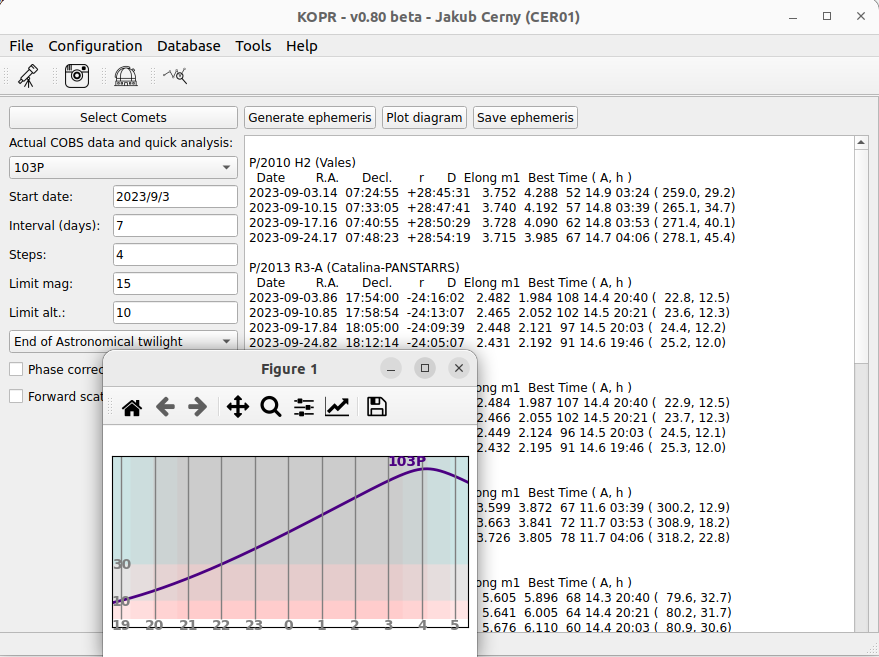
Observation Planner
Generate ephemerides and visibility information, use COBS-supported brightness estimates and prepare single-comet finding charts.
Comet Analyzer
Analyse one or more comet light curves, fit photometric models, compare channels and export calculated colour indices.
Download
The link below downloads the same current Python 3 source archive as the button at the top of this page.
Offline catalogues
These catalogues can be installed locally when the corresponding KOPR workflow should not depend on an online catalogue query.
APASS DR10 to magnitude 14
Selection for comet photometry with stars brighter than V = 14 mag. Download size: 298.4 MB.
APASS DR10 to magnitude 16
Selection for comet photometry with stars brighter than V = 16 mag. Download size: 1.3 GB.
Tycho-2 Catalogue
B and V magnitudes from Tycho-2. Used by KOPR where the local TYC-2 catalogue is selected or required.
Yale Bright Star Catalogue 5
Bright-star catalogue used for finding-chart context. Finding charts are monochrome; B−V is retained only as catalogue metadata.
Installation
KOPR requires Python 3.10 or newer. The installation guide covers Linux, native Windows, Python virtual environments, Astrometry.net and the Windows WSL 2 solver backend.
Video guides
Usage guides and tutorials will be added progressively on the official KOPR YouTube channel.
Documentation
Choose the workflow or reference that matches the task you are performing.
Start here
Install KOPR, complete first-start configuration and select the observing site and instrument.
Visual observations
Comparison-star map, coma and tail measurement, Argelander estimate and ICQ output.
CCD image workflow
Calibration, astrometry, stacking, comet photometry, automatic helpers and ACF review.
Planning and finding charts
Planner configuration, ephemerides, COBS brightness support and printable finding charts.
Light-curve analysis
Multi-comet analysis, formulas, fitting, display controls, scenarios and CSV export.
Comet identity and elements
Designation syntax, local orbital elements and the NASA/JPL SBDB custom-comet loader.
Data and FITS
Accepted inputs, generated metadata, Scientific/Compact FITS storage and output formats.
Troubleshooting
Installation, astrometry, catalogue, image-processing, Planner and photometry diagnostics.
Developer documentation
Architecture, algorithms, testing and implementation contracts for maintainers and contributors.